


Scaling Stablecoin Infrastructure: Usual Uses Ormi’s Subgraph for Real-Time Stablecoin Data
Usual, a stablecoin issuer with $565M+ TVL, uses Ormi’s blockchain indexer and subgraph infrastructure to power real-time, high-integrity data for yield distribution and DeFi integrations.

Usual is a stablecoin issuer building fiat-pegged and synthetic assets on-chain, with $565M+ TVL across its products. Its core offering, USD0, is a dollar-pegged stablecoin, alongside additional assets such as Eur0 and synthetic tokens tied to other underlying references.
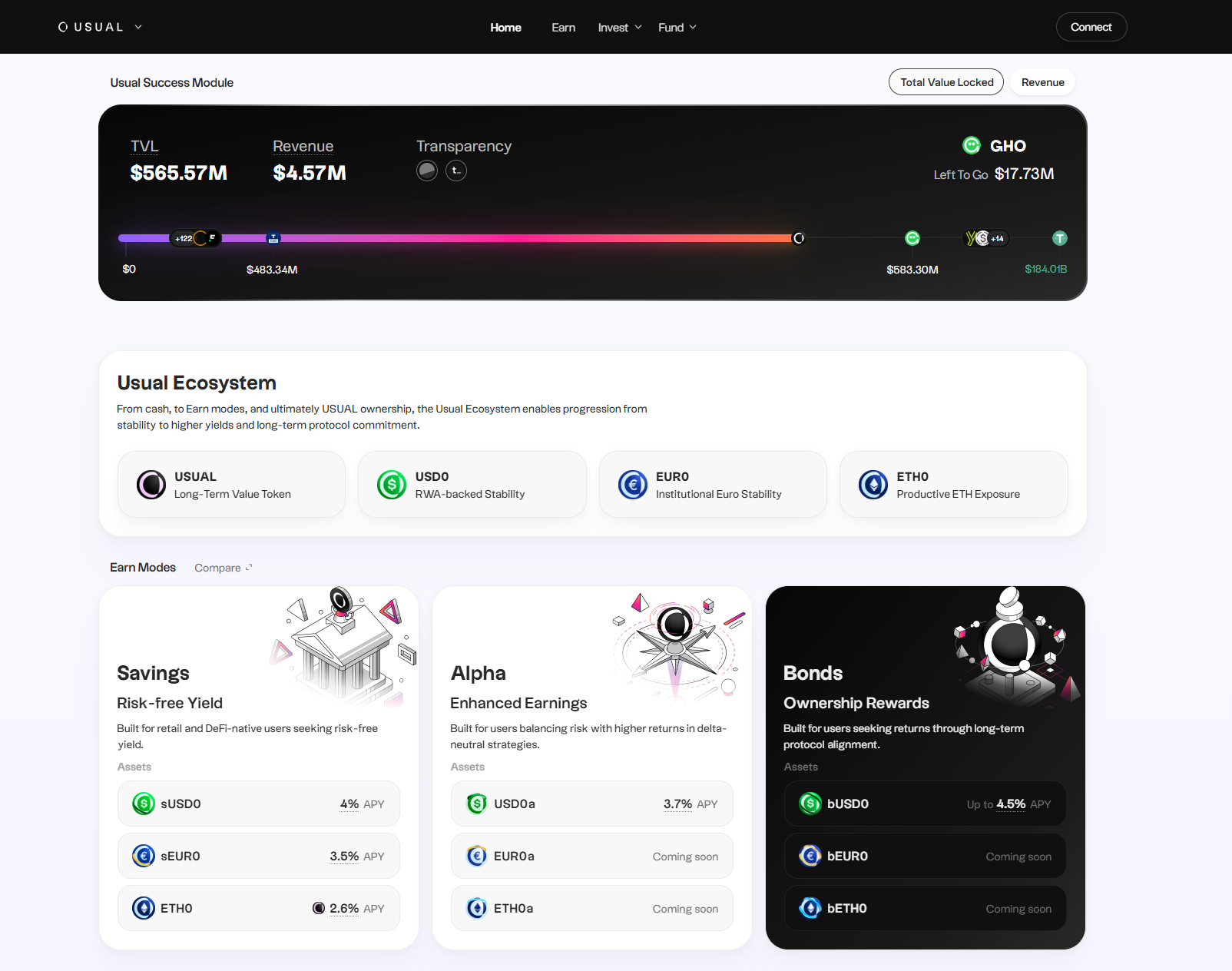
One of its key products, USD0++, allows users to earn yield in USUAL while continuing to deploy their assets across DeFi protocols.
That design introduces a non-trivial requirement: user positions must be tracked continuously across external protocols so that yield can still be calculated and distributed correctly, even when assets move.
As a result, subgraph infrastructure directly impacts the correctness of the product itself.
Related readings: Why subgraphs are made for real-time stablecoin data
The Challenge
Usual needed a way to monitor USD0++ activity across protocols such as Morpho, Euler, and other DeFi venues while preserving accurate daily yield distribution. The indexing layer had to do more than serve queries. It had to support a workflow in production, tied directly to financial calculations and a recurring distribution cycle.
The team had already built a subgraph-based system to power its distribution engine, but several constraints became more pronounced over time.
The first was indexing speed. The subgraph had grown into a large and complex dataset with hundreds of thousands of entities. When updates required retrospective state changes, the team could not always rely on grafting and instead had to reindex the full dataset. That introduced delays that were difficult to absorb in a fast-moving production environment.
The second was availability. Usual runs a daily distribution process. Any outage or degraded service around that window could disrupt internal workflows and delay a core operational process.
The third was data integrity. For a yield distribution system, indexed data has to match the on-chain state exactly. Any mismatch creates operational risk, especially for products designed to serve both retail and institutional users.
“Data integrity and availability are critical for us. Our yield distribution runs on a daily schedule, and any data issues or downtime directly impact the system. We evaluated multiple providers, and Ormi stood out for data integrity, indexing speed, and reliability.”
— Aurelien Garnier | Tech Lead
A high bar for infrastructure
Because yield distribution sits so close to the financial core of the platform, Usual designed its architecture with redundancy in mind. Alongside its subgraph, the team also runs direct RPC-based checks to independently validate the underlying computation.
Even with those safeguards, the subgraph remains foundational. It needed to be fast, available, and trustworthy under real production conditions.
That led the team to reevaluate providers.
Why Ormi
In assessing the market, three criteria mattered most:
- data integrity,
- availability, and
- indexing speed.
Ormi stood out quickly.
Its platform delivered the strongest overall performance against the metrics that mattered most to Usual’s team. Indexed data quality was dependable, update performance was strong, and the service met the availability requirements needed to support a daily distribution operation without introducing avoidable operational stress.
Brand confidence also played a role. Among the providers evaluated, Ormi stood out as a credible infrastructure partner with the operational maturity expected for a system supporting financial products at scale.
The Result
With Ormi in place, Usual strengthened the infrastructure behind one of its most operationally sensitive workflows, which:
- improve confidence in the accuracy of indexed on-chain data
- support daily yield distribution with a more dependable service layer
- reduce operational exposure to provider instability and downtime
- maintain performance as the subgraph and integration footprint continued to grow
For Usual, subgraph infrastructure is more than developer tooling. It is big part of the system that makes composable yield-bearing products possible.
As on-chain financial products become more sophisticated, that distinction matters more. The ability to track assets accurately across DeFi, update indexing logic quickly, and rely on consistent service availability is essential to delivering a product users can trust.
Customer story
About Usual
Usual is a secure, decentralized fiat stablecoin issuer that redistributes ownership, governance, and value to its community through the USUAL token.
Usual addresses a core imbalance in today’s stablecoin market: users supply the capital that generates billions in revenue, but they typically receive none of it. Usual reverses that model 100% of the value generated flows back to the community.
About Ormi
Ormi is the next-generation data layer for Web3, purpose-built for real-time, high-throughput applications like DeFi, gaming, wallets, and on-chain infrastructure. Its hybrid architecture ensures sub-30ms latency and up to 4,000 RPS for live subgraph indexing.
With 99.9% uptime and deployments across ecosystems representing $50B+ in TVL and $100B+ in annual transaction volume, Ormi is trusted to power the most demanding production environments without throttling or delay.