


Stablecoins are real-time. Your data stack should be too.
Stablecoins demand real-time, reliable data. Ormi delivers sub-30ms indexing, high-throughput APIs, and AI-ready infra, built for apps that cannot afford to lag.

This post explains why stablecoin workloads require real-time data infrastructure. If you’re looking for a detailed understanding on accessing real-time stablecoin data using subgraphs, see this guide.
Payment rails are changing. The data infrastructure has to change with them.
In 2024, stablecoins moved over $27.6 trillion in on-chain value, surpassing Visa and Mastercard. Stripe now pays out in USDC. Circle’s cross-chain protocol is going mainstream.
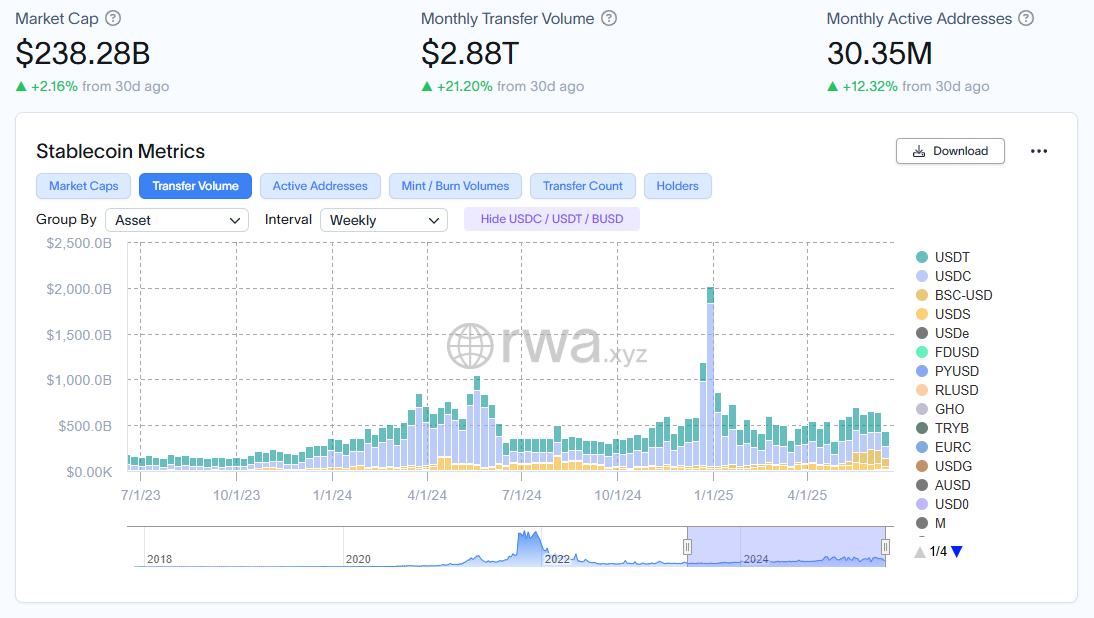
In the past 30 days, stablecoins have moved $2.88 trillion in transfer volume, according to rwa.xyz.
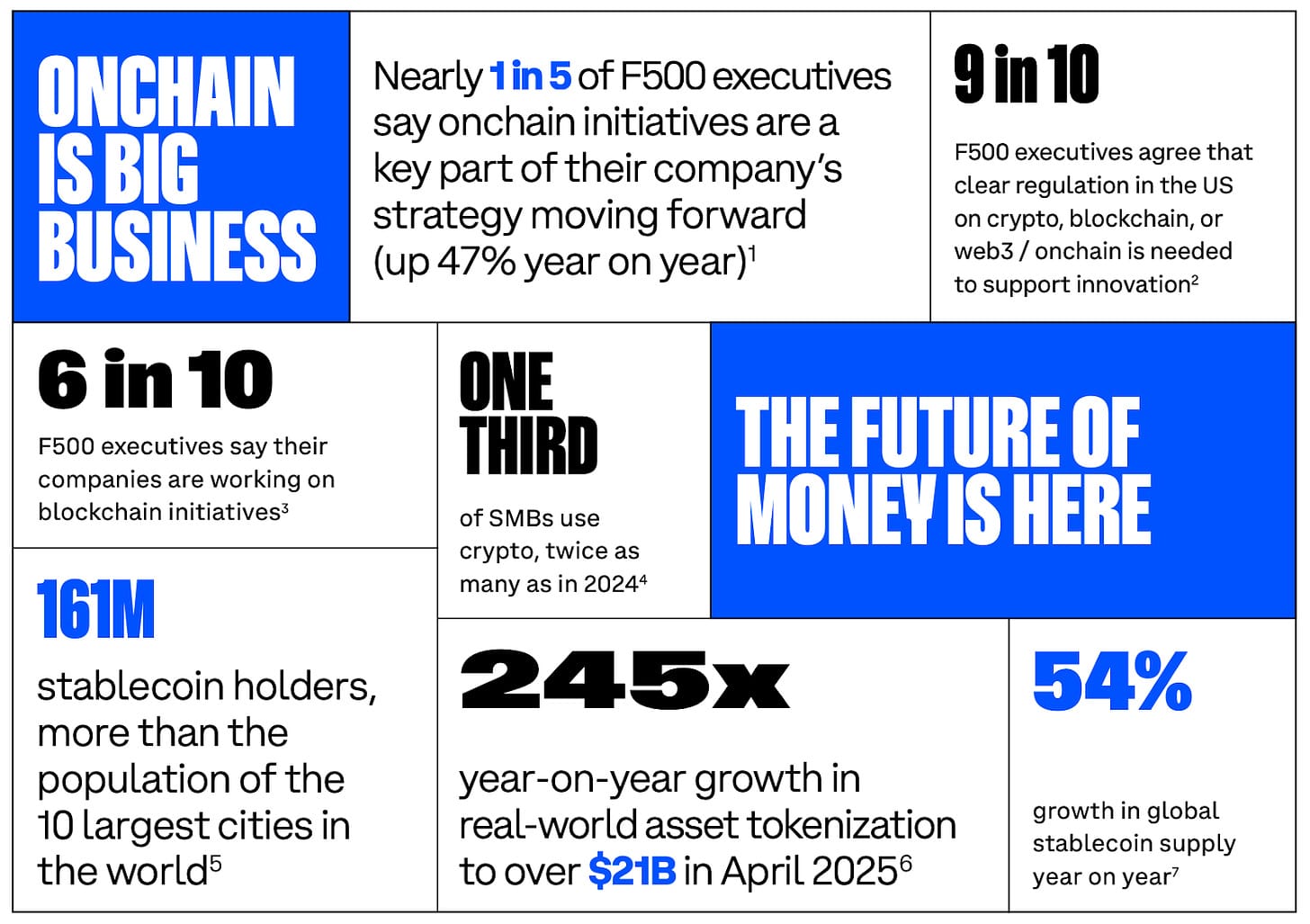
A Coinbase survey found that 6 in 10 F500 executives are engaged in blockchain initiatives. At the same time, more than 160 million people now hold stablecoins.
Payment processors, wallets, and treasury platforms are moving quickly to integrate them. The reasons are obvious: lower fees, faster settlement, and global access without the friction of traditional banking rails.
But once product teams actually ship stablecoin features, many run into the same problem.
It works in staging. But in production, it starts to fall apart.
Wallets do not reflect real-time balances, transfers don’t show up immediately or compliance misses the latest mints or burns. These issues are what is shown on the front-end, and they all point to data availability and latency issues. The underlying problem is simple: the stablecoin economy moves in real time, but most data infrastructure doesn’t.
Legacy blockchain infrastructure wasn't built for real-world finance
Many teams still rely on legacy indexing setups built for dashboards, analytics, or slow-moving protocols.
These systems typically:
- index only finalized blocks, introducing an unavoidable delay,
- capture on-chain events, but not real-time contract state,
- struggle with reorgs, chain congestion, or high TPS environments, and
- can take hours, or even days, to sync fully on fast chains like BNB and Arbitrum.
When chains started producing 250+ TPS, indexers could not keep up. That’s exactly what happened with several dApps on Berachain, until they came to Ormi.
Berachain’s mainnet TGE was disrupted by throttling - read how Ormi deployed a dedicated subgraph in under 5 hours to restore real-time data access.
What this means for developers working with stablecoins
If you’re building wallets, payment apps, compliance systems, or stablecoin-based infrastructure, real-time data is not optional.
Stablecoin applications require accurate balances that update instantly.
See the Ostium case study: how real-time subgraph indexing fixed missing trades during high-volume trading.
Stale blockchain data caused missing trades for Ostium, a decentralized RWA trading platform trading $300M+ a day. Ormi Subgraphs restored consistent, real-time indexing at scale.
This is why many teams move beyond RPC polling and analytics-focused indexers and adopt real-time subgraph infrastructure built for production workloads.
Not all subgraphs are created equal
Ormi’s 0xgraph is fully compatible with The Graph’s subgraph, but instead of running subgraphs on a best-effort basis, we run them in our purpose-built, high-performance environment. We hate stale data and buggy infrastructure.
0xgraph is a next-generation subgraph indexer designed to meet today’s demands. Where others run generic infrastructure across shared clouds, Ormi runs on a “bare- metal + cloud” infrastructure, purpose-built for throughput and uptime.
This lets us:
- scale up with faster block production,
- scale out across 70+ supported chains,
- deliver sub-30ms latency even at 1,000+ RPS, and
- syncs 5x faster than competitors to stay at the tip of the chain.
When Berachain launched and legacy providers lagged, Ormi delivered a production-ready subgraph within 5 hours.
When Pendle Finance scaled from $2B to $6B TVL, it ran on Ormi.
Learn how real-time subgraphs helped Pendle scale fast to $6B TVL.
The cost of lag is real
Stablecoin infrastructure requires speed, precision, and visibility. Without real-time data access:
- wallets display the wrong balance,
- payouts fail due to missing confirmations,
- compliance pipelines break under multi-chain deployments, and
- treasury platforms miscalculate exposure or reserves.
RPC polling simply isn’t enough. RPC nodes are often rate-limited and require constant maintenance by the engineering or development teams.
As block production gets faster and apps go multichain, these issues don’t get better. They compound.
Ormi 0xGraph is built for real-time crypto and stablecoins
Ormi’s 0xGraph was built for this future, where payments happen cross-chain, where finance happens in real time, and where uptime isn’t optional.
Ormi 0xGraph is:
- Subgraph compatible: Migrate in clicks. Use familiar tooling.
- Production-ready: Built for 99.9% uptime, even during reorgs or congestion.
- Real-time + historical data: Query current contract state or replay history instantly.
- Battle-tested: Proven in high-pressure, high-speed, multi-chain environments.
- Supports over 70+ chains: From Ethereum to Arbitrum, Solana, Berachain, and more.
“We also sync 5x quicker and query 71% faster than competitors”
Crypto is the new payment rails. Ormi is purpose-built for it.
The promise of stablecoins is composable, instant, global money. But that promise only works if infrastructure keeps up. The winners in this wave of stablecoin adoption will be the teams that can build fast, ship confidently, and automate everything, from payments, reporting, and reconciliation, without worrying about what their data provider will do under pressure. If your app touches stablecoins, your data infrastructure is now financial infrastructure.
Don't settle for tools built for dashboards.
About Ormi
Ormi is the next-generation data layer for Web3, purpose-built for real-time, high-throughput applications like DeFi, gaming, wallets, and on-chain infrastructure. Its hybrid architecture ensures sub-30ms latency and up to 4,000 RPS for live subgraph indexing.
With 99.9% uptime and deployments across ecosystems representing $50B+ in TVL and $100B+ in annual transaction volume, Ormi is trusted to power the most demanding production environments without throttling or delay.