


Best Blockchain Indexers in 2026
Compare the best blockchain indexers for Web3 apps, including Ormi, The Graph, Goldsky, Covalent, Envio, and Ponder. Learn how they differ on freshness, latency, reorg handling, APIs, and production reliability.

Last updated: May 2026
This guide reflects production criteria for blockchain indexing, smart contract indexing, and real-time Web3 data, including freshness, reorg handling, and high-throughput performance.
Intro
Choosing a blockchain indexer is no longer just a developer tooling decision.
The indexer sits between raw blockchain data and the product experience users actually see. It affects how quickly data updates, how reliably applications handle reorgs, how fast queries return, and whether the system can keep working under real production load.
This guide compares the best blockchain indexers in 2026, including Ormi, The Graph, Goldsky, Covalent, Envio, and Ponder. We look at them through the lens that matters most for engineering teams: data freshness, query performance, reorg handling, scalability, chain support, and operational reliability.
So, what is a blockchain indexer?
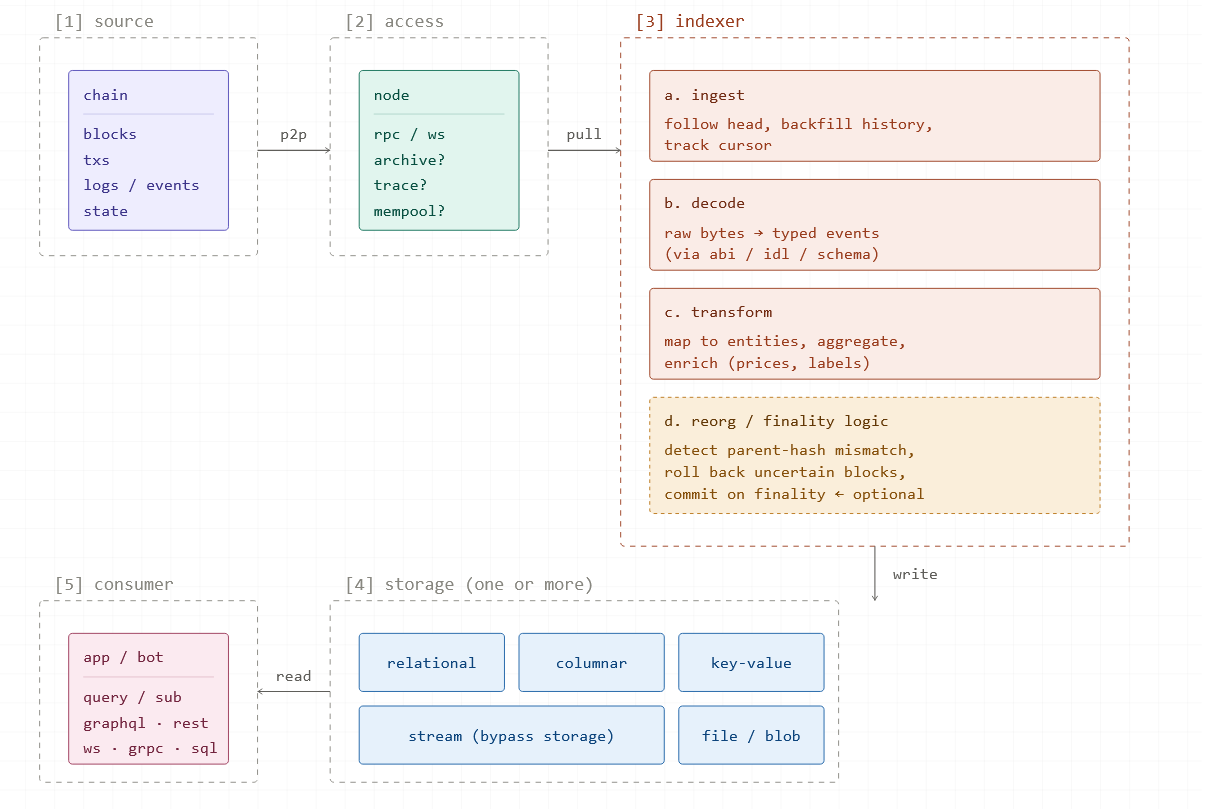
A blockchain indexer reads raw blockchain data, including blocks, transactions, logs, and smart contract events, and turns it into structured data that applications can query.
Indexers exist because blockchains are optimized for writing and verifying transactions, not for fast reads, filtering, aggregation, or historical queries. Without an indexer, applications often need to scan logs, decode events, join data manually, and rebuild state every time they need an answer.
For Web3 applications, indexers power the data behind wallets, DeFi dashboards, trading systems, analytics tools, bots, AI agents, and user-facing applications that depend on accurate on-chain data.
Blockchain indexer vs RPC vs blockchain API
- RPC gives direct access to blockchain nodes. It is best for submitting transactions, reading low-level contract state, and fetching blocks or receipts.
- A blockchain indexer processes raw chain data into structured datasets for faster querying, filtering, aggregation, and application-specific state.
- A blockchain API exposes that data through developer-friendly endpoints. Many APIs are powered by indexers underneath.
- Most production applications use more than one: RPC for transactions, indexers for protocol state, and APIs for common data access.
Related readings: What is a web3 API
How we evaluated the best blockchain indexers
Feature lists rarely reflect production reality. What matters is how systems behave under stress.
We evaluated indexers based on:
#1 Tip of the chain freshness
Latency alone is misleading. The real measure is how closely indexed data aligns with the chain head during spikes.
#2 Throughput stability
Can the indexer sustain high request volume without throttling, degradation, or dropped data?
#3 Reorg handling
Does the indexer automatically detect and reconcile chain reorganizations, or does data drift occur silently?
#4 Historical backfills
Can large reindexes run reliably without downtime or manual intervention?
#5 Operational visibility
Can engineers monitor indexing lag, block distance, database pressure, and failures in real time?
These factors separate production-grade infrastructure from developer tooling.
| Indexer | Best For | Query Interfaces | Typical Latency | Chain Support | Hosting Model | Chain-Head Freshness |
|---|---|---|---|---|---|---|
| Ormi | Real-time, high-throughput production apps | GraphQL, REST, SQL | Sub-30ms | 70+ | Managed | Stays at tip of chain |
| The Graph | Standardized subgraphs and ecosystem tooling | GraphQL | Few hundred ms | 40+ | Decentralized / Managed | Not tip of chain |
| Covalent | Wallets and multi-chain data access | REST APIs | Hundreds of ms | 100+ | Managed | No |
| Goldsky | Event streaming and fast backfills | Event APIs, GraphQL | Sub-second | 100+ | Managed | Depends, data correctness handled client-side |
| Envio | Performance-focused self-hosted indexing | GraphQL | Sub-second | Select | Self-hosted | Depends, infra-dependent |
| Ponder | Fully custom indexing stacks | GraphQL, SQL | Few hundred ms | EVM | Self-hosted | Depends, engineering-dependent |
Still deciding which indexing model fits your app?
This comparison focuses on the leading blockchain indexers and where each one performs best. If you are still deciding between subgraphs, Data APIs, SQL, custom indexing, or managed infrastructure, read our guide on how to choose the best Web3 data indexer.
How we compare blockchain indexers
We compare indexers using production criteria:
- Chain-head distance during spikes
- Reorg handling and correctness
- Backfill speed and reliability
- Throughput stability at 500 to 1,000+ RPS
- Observability and debugging tools
- Supported chains and long-term operability
The TL;DR for top blockchain indexers in 2026
- Best overall blockchain indexer for real-time apps: Ormi
- Best decentralized subgraph ecosystem: The Graph
- Best event-focused indexing: Goldsky
- Best open-source performance-first indexer: Envio
- Best fully custom self-hosted indexing: Ponder
Read more about why Ostium, a perp exchange transacting $300M+ / day, migrated to Ormi from Goldsky & Alchemy.
#1. Ormi: Best blockchain indexer for real-time production apps
Best for
DeFi dashboards, trading platforms, gaming, wallets, AI agents, and applications where data freshness directly impacts outcomes.
Why teams choose it:
- Sub-30ms query latency at 4,000+ RPS
- Real-time subgraph indexing compatible with The Graph
- GraphQL, and REST in a single platform
- Full reorg resilience and fast historical backfills
- 70+ supported chains
- No throttling under load
Ormi is purpose-built for high-throughput chains and latency-sensitive workloads. Its hybrid architecture combines bare-metal performance with cloud elasticity, keeping data aligned with the chain head even during extreme traffic.
Unlike cloud-only indexers, Ormi is designed with redundancy at every layer: RPC ingestion, routing, storage, compute, and query execution. This prevents missing blocks, silent lag, and invisible downtime under load.
#2. The Graph: Best for standard Subgraphs ecosystem coverage
Best for
Teams that rely on standardized, community-maintained subgraphs and ecosystem compatibility.
Strengths
- Widely adopted subgraph standard
- Large ecosystem of public subgraphs
- Decentralized indexing network
The Graph pioneered declarative blockchain indexing and remains a foundational part of the Web3 ecosystem. It is well-suited for standardized use cases, but less optimized for high-frequency or real-time production workloads.
#3. Covalent: Best for multi-chain REST APIs
Best for
Wallets, explorers, and applications that need fast access to balances and transactions across many chains.
Strengths
- Unified REST APIs
- Broad chain coverage
- Fast prototyping
Covalent excels at common data access patterns, but offers limited flexibility for protocol-specific logic, complex smart contract indexing, or real-time applications.
#4. Goldsky: Great for fast backfills
Best for
Teams that need to stream blockchain events into downstream systems.
Strengths
- Low-latency event delivery
- Flexible streaming pipelines
Goldsky focuses on event extraction rather than full application-facing indexing. This works well for pipelines and backfills, but shifts responsibility for reorg handling, correctness, and state reconstruction to the client.
5. Envio: Most flexible way to index on-chain data
Best for
Teams that want a fast way to index data without worrying about chain support.
Strengths
- Performance-first design
- Customizable indexing logic
Envio provides speed and flexibility, but requires teams to manage infrastructure, scaling, monitoring, and reliability themselves.
#6. Ponder: Best for fully custom self-hosted indexing
Best for
Teams with strong DevOps expertise and highly specialized requirements.
Strengths
- Full control over indexing pipelines
- Flexible data modeling
Ponder offers maximum customization at the cost of significant operational overhead.
Why real-time blockchain data breaks many indexers
As chains increase throughput, indexing becomes harder.
Common failures include:
- throttling under load
- RPC instability and partial block ingestion
- incomplete reorg handling
- database write saturation
Many indexers perform well in benchmarks but fail under sustained production traffic. This leads to silent data drift, missing trades, and incorrect state in live applications.
Ormi is built to surface and eliminate these issues through continuous validation, multi-source ingestion, and real-time observability.
Need help choosing the right indexing model?
The best provider depends on the workload. A real-time trading app, wallet, analytics dashboard, and AI agent each need different data guarantees.
- Do you need real-time or eventual consistency?
- Can your app tolerate missing blocks or delayed updates?
- Do you want managed infrastructure or full control?
- Is historical data as critical as live data?
- Do you need GraphQL, REST, SQL, or all three?
If you are still deciding between subgraphs, Data APIs, SQL, custom indexing, or managed infrastructure, read our full guide on how to choose the best Web3 data indexer.
Summary: Best Web3 indexers in 2026
| Category | Winner |
|---|---|
| Best Overall Real-Time Indexer | Ormi |
| Best Decentralized Subgraph Platform | The Graph |
| Best Multi-Chain REST APIs | Covalent |
| Best Event Pipelines | Goldsky |
| Most Flexible Indexer | Envio |
| Best Self-Hosted Custom Stack | Ponder |
Further reading
- What is blockchain indexing? Types, limitations, and tools
- How Web3 apps query smart contract data in real-time
- How to choose the best Web3 data indexer for production
Frequently asked questions about blockchain / web3 indexers
What is a blockchain indexer?
A blockchain indexer is infrastructure that processes raw blockchain data and transforms it into structured, queryable formats such as GraphQL, REST, or SQL. Indexers make it possible for Web3 applications to query historical and real-time on-chain data efficiently.
Why do web3 apps need a blockchain indexer?
Blockchains are optimized for writing data, not reading it. Without an indexer, applications cannot efficiently query transactions, balances, events, or contract state. Indexers are essential for dashboards, wallets, trading systems, bots, analytics, and AI agents.
What is the difference between RPC nodes and blockchain indexers?
RPC nodes provide direct access to blockchain state but are limited for historical queries, filtering, and high-throughput workloads. Blockchain indexers continuously process blocks and events into optimized databases, enabling fast, scalable queries and real-time updates.
What does "tip of chain freshness" mean?
Chain-tip freshness refers to how closely an indexer’s data stays aligned with the latest block on the blockchain. An indexer with high chain-head freshness continues indexing in real time during traffic spikes, volatility, and reorgs, instead of silently lagging behind.
What makes Ormi different from other blockchain indexers?
Ormi is built specifically for real-time, production-grade indexing. It stays at the tip of the chain, capable of elastic scaling without throttling, sub-second performance under load, and full reorg handling across a vertically integrated bare-metal and cloud stack.
About Ormi
Ormi is the next-generation data layer for Web3, purpose-built for real-time, high-throughput applications like DeFi, gaming, wallets, and on-chain infrastructure. Its hybrid architecture ensures sub-30ms latency and up to 4,000 RPS for live subgraph indexing.
With 99.9% uptime and deployments across ecosystems representing $50B+ in TVL and $100B+ in annual transaction volume, Ormi is trusted to power the most demanding production environments without throttling or delay.