


What is a Web3 API?
A practical guide to the different types of Web3 APIs, including RPC, Data APIs, subgraphs, SQL, and streaming, and how to choose the right one for your application.

Applications cannot process raw blockchain data. They need human-readable outputs.
- Wallets need to show a user’s balances, NFTs, and transaction history.
- DeFi apps need to show positions, rewards, swaps, and risk metrics.
- Stablecoin platforms need to monitor transfers, mints, burns, and settlement activity across chains.
- AI agents need the current state to act on.
A Web3 API is the interface that makes this possible. It helps applications read blockchain data, query indexed datasets, stream events, or submit signed transactions to a blockchain network.
The important thing to understand is that “Web3 API” is a broad term. It can refer to:
- a low-level RPC endpoint,
- a REST API for balances and transfers,
- a GraphQL endpoint powered by a subgraph,
- a SQL interface for analytics, or
- a streaming feed for real-time events.
These are all Web3 APIs, but they are not the same thing. Each one is built for a different kind of workload.
Why Web3 APIs exist
Blockchains are good at recording transactions, verifying state, and maintaining consensus. They are not designed to behave like application databases.
A blockchain RPC node can answer low-level questions. It can tell you the balance of an address, return a transaction receipt, fetch a block, or call a smart contract function.
But most applications need data that has already been decoded, structured, enriched, and organized around the way the product works. Indexers, data pipelines, or other backend infrastructure usually handle that work.
For example, a wallet does not want to scan every token contract to build a balance view. A DeFi dashboard also does not want to reconstruct a user’s position from deposits, borrows, repayments, and liquidations every time the page loads.
A Web3 API is the interface that exposes that data to applications.
Web3 API is not a single thing
The easiest way to understand Web3 APIs is to group them by workload: raw access, product-ready data, custom protocol state, analytics, and real-time events.
Some APIs give you direct access to a blockchain node. Some return product-ready data such as balances, transfers, or metadata. Some expose custom protocol data through GraphQL. Some support flexible analysis through SQL. Some deliver events as they happen.
The right API depends on what your application needs to do.
RPC APIs give you raw access to the chain
RPC is the lowest-level Web3 API. On Ethereum and other EVM chains, developers use JSON-RPC methods such as eth_getBalance, eth_call, eth_getTransactionReceipt, eth_getLogs, and eth_sendRawTransaction.
RPC connects applications to blockchain nodes. It is the standard way to submit transactions, read current contract state, inspect receipts, fetch blocks, and debug low-level chain behavior.
RPC is powerful because it sits close to the chain. If your application needs to send a signed transaction, call a smart contract, or check a specific transaction, RPC is usually the right tool.
Where RPC is inefficient is broad querying. It is not designed to answer questions like “show this user’s full trading history,” “calculate protocol volume by day,” or “list every token transfer for this wallet over the last year.”
You can try to answer those questions with RPC, but it will require scanning logs, decoding events, joining data manually, caching responses, and writing backfill scripts. At that point, you're essentially building an indexer.
Related readings: How to choose the best Web3 data indexer
Data APIs provide product-ready blockchain data
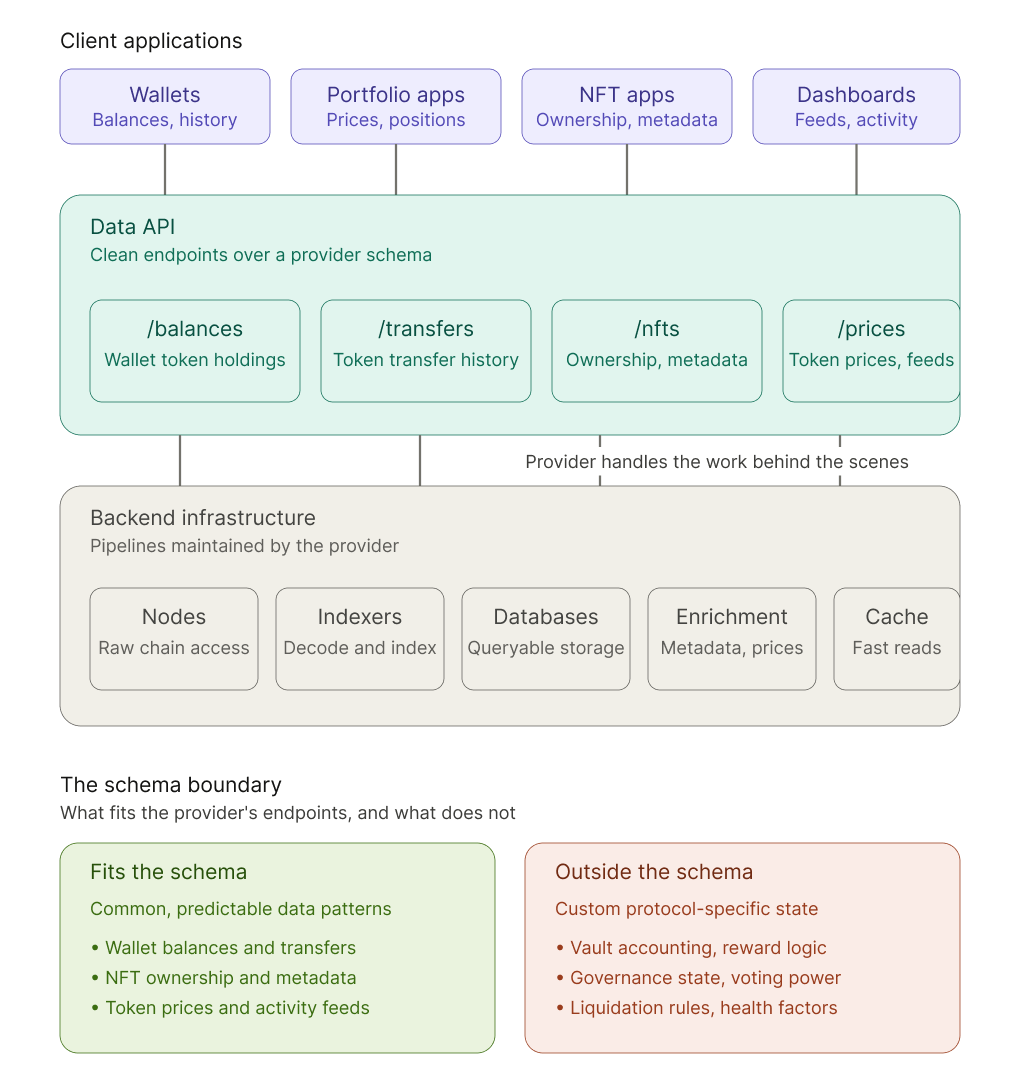
Data APIs package common blockchain data into clean endpoints. Instead of calling raw RPC and decoding everything yourself, you ask for the object your application actually needs.
A Data API might return wallet balances, token transfers, NFT ownership, token metadata, transaction history, prices, or activity feeds.
This is useful because the provider handles the work behind the scenes. The API is usually backed by nodes, indexers, databases, enrichment pipelines, and caching layers. The developer gets a simpler interface.
Data APIs work best when the data model is common and predictable. Wallets, portfolio apps, NFT apps, mobile apps, token pages, and consumer dashboards often rely on them because they make standard data easy to integrate.
The tradeoff is flexibility. A Data API is limited by the provider’s schema.
For example, a generic Data API may know how to return token balances, but it may not understand a protocol’s custom vault accounting, reward logic, governance state, or liquidation rules.
Data APIs are excellent for common data patterns. They are less useful when your application needs custom protocol-specific state.
Subgraph and GraphQL APIs expose custom application state
Some applications need a data model that matches their protocol. That is where subgraphs and GraphQL APIs are useful.
A subgraph defines how raw smart contract activity becomes structured data. It specifies which contracts to track, which events matter, and how those events update entities such as users, pools, swaps, positions, vaults, orders, or rewards.
The result is exposed through GraphQL, which lets applications query the exact fields they need.
This model is useful because it matches how applications think. A lending app does not want to reconstruct deposits, borrows, repayments, liquidations, and collateral changes on every request. It wants a user position. A subgraph can maintain that derived state and expose it through a query interface.
Subgraphs are common in DeFi dashboards, DEX analytics, lending interfaces, staking systems, NFT marketplaces, governance dashboards, and protocol activity feeds.
The limitation is that subgraphs simplify the query layer, but may not capture specific data if the contract does not emit the right events.
SQL APIs support flexible analysis over blockchain history
SQL APIs expose blockchain data through tables. Instead of calling a fixed endpoint, analysts and engineers can write queries over historical datasets.
This is useful because many blockchain questions are exploratory. A team may want to know how much volume moved through a protocol last month, which wallets interacted with a contract before a launch, how stablecoin flows changed after a market event, or which pools generated the most fees.
Those questions do not always fit neatly into a REST endpoint or GraphQL schema. SQL gives teams the flexibility to ask new questions without rebuilding the data pipeline each time.
SQL APIs are a good fit for analytics, research, compliance, reporting, stablecoin monitoring, treasury analysis, cross-chain comparisons, data science workflows, and AI-ready datasets.
The tradeoff is serving performance. SQL can be fast with the right infrastructure, but it is usually optimized for analysis rather than low-latency product reads.
A wallet should not run a large SQL query every time a user opens the app. A trading interface should not depend on a slow analytical query to render the current state. SQL is powerful, but it should be used for the right workload.
Streaming APIs and webhooks deliver data as it happens
Some applications need to react to blockchain activity quickly. They do not want to ask an API what happened every few seconds. They want events delivered as they occur.
That is the role of streaming APIs, WebSockets, and webhooks.
These systems can deliver new blocks, contract events, token transfers, pending transactions, payment confirmations, liquidation alerts, treasury movements, and risk signals.
Streaming works well for alerts, monitoring, trading systems, liquidation workflows, fraud detection, payment notifications, AI agents, event-driven backends, and live dashboards.
It also changes how the application is built. Instead of polling repeatedly, the application receives events and reacts.
The tradeoff is that a stream is not a database. It gives you data in motion, but you still need to store, query, replay, and reconcile that data if your application depends on history or state.
Streaming systems also need careful handling of ordering, retries, duplicate events, reorgs, backpressure, missed events, and downstream failures.
Data freshness matters
One of the biggest differences between Web3 APIs is freshness.
Freshness means how close the data is to the latest block. For some use cases, a few minutes of delay is acceptable. For others, even a few seconds can matter.
A compliance dashboard may tolerate some lag. A trading system may not. An AI agent acting on live state may need data that stays close to the tip of the chain.
In general, RPC and WebSockets are closest to the chain because they read directly from nodes. Streaming APIs and webhooks are usually very fresh because they deliver events shortly after they happen. Subgraphs and Data APIs can be sub-second behind the chain tip, but they depend on the indexing infrastructure.
SQL APIs and data warehouses may range from seconds to minutes or hours behind, depending on how the pipeline is built.
How to choose the right Web3 API
The best way to choose a Web3 API is to start with the workload.
- If you need to submit transactions, use RPC. It is the standard path for broadcasting signed transactions.
- If you need simple current-state reads, RPC may be enough. If the same read pattern happens repeatedly at scale, a low-latency indexed API may be better.
- If you need balances, transfers, metadata, or wallet activity, use a Data API. This is usually the fastest path for wallets, portfolio apps, and consumer products.
- If you need custom protocol state, use a subgraph or GraphQL API. This is the right fit when your data model is specific to your application or protocol.
- If you need historical analytics, use SQL. It is best for research, reporting, compliance, and exploratory questions.
- If you need to react to events quickly, use streaming, WebSockets, or webhooks. These are better for alerts, monitoring, automation, and event-driven systems.
It's common for applications to need more than one interface. For example, an app might use RPC for transactions, a Data API for balances, a subgraph for protocol state, SQL for analytics, and streaming for alerts.
That is normal. The mistake is expecting one interface to solve every problem.
Common mistakes
The first mistake is using RPC for everything. RPC is necessary, but it is not a complete data layer.
The second mistake is choosing an API before defining the data model. It is easy to pick a provider too early, before it is clear what the application actually needs to answer. Start with the data model, then choose the right interface.
The third mistake is ignoring freshness. Fast responses do not help if the data is stale.
The fourth mistake is forgetting reorgs. If your application depends on recent blockchain activity, reorg handling matters.
The fifth mistake is treating all chains the same. Different chains have different throughput, finality, data structures, and RPC behavior. A good Web3 API abstracts complexity where possible.
The takeaway
A Web3 API is the interface between raw blockchain systems and usable applications.
Some APIs give direct chain access. Others provide product-ready data, expose protocol-specific state, support analytics, or deliver real-time events.
The right choice depends on the workload.
About Ormi
Ormi is the next-generation data layer for Web3, purpose-built for real-time, high-throughput applications like DeFi, gaming, wallets, and on-chain infrastructure. Its hybrid architecture ensures sub-30ms latency and up to 4,000 RPS for live subgraph indexing.
With 99.9% uptime and deployments across ecosystems representing $50B+ in TVL and $100B+ in annual transaction volume, Ormi is trusted to power the most demanding production environments without throttling or delay.