


Ormi Subgraphs Now Supports Robinhood Chain
Ormi Subgraphs now indexes Robinhood Chain. Query contracts, assets, transfers, trades, and liquidity with a GraphQL endpoint. No RPC nodes or indexing stack required.

Ormi Subgraphs now supports Robinhood Chain. Starting today, you can index contracts, assets, accounts, transfers, trades, and liquidity positions from Robinhood Chain and query them through GraphQL, without running your own nodes or indexing stack.
What is Robinhood Chain?
Robinhood Chain is a permissionless, EVM-compatible Layer 2 for tokenized finance. The Robinhood Chain was built on Arbitrum's Layer 2 stack to bring equities, ETFs, private assets, and other financial instruments onchain, where they can be transferred, traded, held, and used as collateral across applications.
The company behind it reports 27.7 million funded customers and $377 billion in total platform assets across equities, options, crypto, and cash (Robinhood, May 2026). Robinhood Chain moves that market into an open, programmable environment.
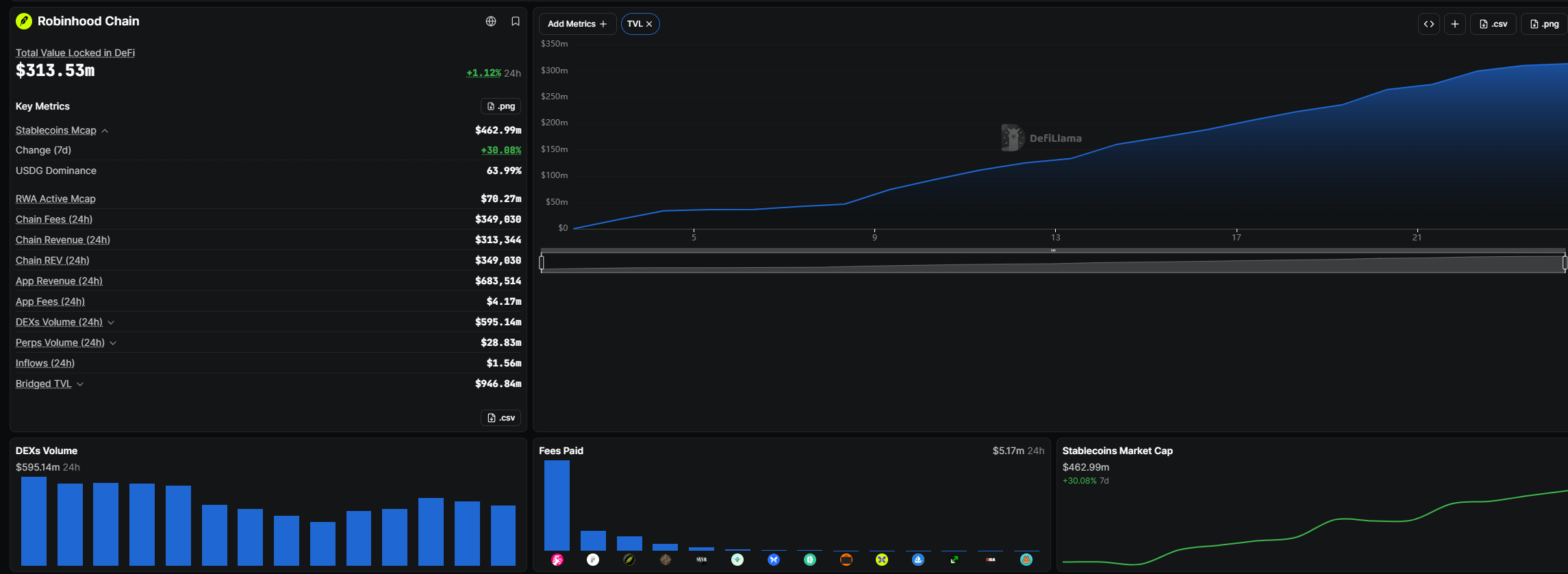
Since launch, Robinhood Chain has drawn roughly $313 million in total value locked, about $946 million in bridged value, and close to $70 million in active real-world asset (RWA) market cap. Those numbers shift as the ecosystem grows, but they mark the volume of activity your application will need to read and show users.
Why tokenized assets are harder to index
A tokenized equity carries more state than a plain ERC-20. To render a single position, your app has to answer questions like:
- Which traditional asset does the token represent?
- How many tokens does an account hold?
- When were tokens minted, transferred, or redeemed?
- Where is the asset traded or pledged as collateral?
- How have supply and ownership changed over time?
Some of this lives onchain. The rest, including live prices and asset metadata, comes from offchain sources. Combining both into something an interface can query is the work.
Why subgraphs are better than RPC for indexing
A blockchain records transactions. It does not answer product questions. A wallet cannot ask the chain for an organized history of every tokenized asset a user owns. Similarly, a trading platform cannot pull historical volume, liquidity, and account activity in one RPC call.
Having to build that pipeline would require node maintenance, scanning logs, storing historical data, and handling chain reorganizations, while keeping the index in sync as new blocks arrive.
A subgraph replaces that work. It listens to the contracts you choose and turns their events into structured entities such as Asset, Account, Balance, Transfer, Trade, and Position. The app can then query those entities in GraphQL instead of reconstructing them from raw logs on every request.
For RWAs on Robinhood Chain, a subgraph can index:
- Transfers and holder balances
- Mint, burn, and redemption activity
- DEX swaps and liquidity pools
- Lending deposits and collateral positions
- Cross-chain asset movements
- Account and transaction histories
- Protocol-level RWA activity
The schema can be defined around the use case or product needs.
What you can build on Robinhood Chain with Ormi Subgraphs
With Robinhood Chain live on Ormi, you can build custom indexing for:
- Wallets that show a user's full tokenized-asset holdings
- Tokenized-asset and trading platforms
- Block explorers and analytics products
- Lending protocols tracking collateral and positions
- AI agents that read live onchain financial data
As more assets and protocols move onto the network, reliable indexing is crucial for the apps built on top of it.
FAQ
Does Ormi support Robinhood Chain? Yes. Subgraphs on Ormi can index and serve live Robinhood Chain data as of today.
What can I query? Any smart contract data.
Do I need to run my own node or indexer? No. Ormi handles indexing, historical data, and chain reorganizations. You write the schema and query the entities.
What is Robinhood Chain built on? An EVM-compatible Layer 2 built with Arbitrum's technology, focused on tokenized equities, ETFs, and other real-world assets.
About Ormi
Ormi is the next-generation data layer for Web3, purpose-built for real-time, high-throughput applications like DeFi, gaming, wallets, and on-chain infrastructure. Its hybrid architecture ensures sub-30ms latency and up to 4,000 RPS for live subgraph indexing.
With 99.9% uptime and deployments across ecosystems representing $50B+ in TVL and $100B+ in annual transaction volume, Ormi is trusted to power the most demanding production environments without throttling or delay.