


How Steer Protocol indexes liquidity data across 45+ chains with Ormi Subgraphs
Steer Protocol runs automated liquidity strategies across 45+ chains and 60 DEXs. This case study explains why reliable blockchain indexing became critical infrastructure for real-time liquidity decisions and why Steer expanded its usage of Ormi.

Automated liquidity management systems depend on accurate blockchain data.
When that data is delayed, incomplete, or inconsistent across chains, automated strategies begin making incorrect decisions. Liquidity can be repositioned at the wrong time. Trades can execute against outdated market conditions.
For applications operating across dozens of chains and exchanges, these failures quickly become financial risk.
Steer Protocol operates one of the largest automated liquidity management systems in DeFi. To run this infrastructure reliably, the team needed an indexing layer capable of supporting real-time decision systems across many networks.
TL;DR: Why Steer chose Ormi
Steer evaluated indexing providers based on a few core operational requirements:
- Fast synchronization across chains
- Reliable performance under production workloads
- High data integrity for event-heavy markets
- Responsive engineering support when issues arise
For Steer, stale data and failed requests were not acceptable. Their liquidity automation system depends on fresh, accurate indexed data to make real-time decisions across dozens of chains.
Context
Steer Protocol is an automated liquidity management platform used by token teams to launch and maintain on-chain markets.
Instead of manually managing liquidity pools, projects deploy automated strategies that monitor blockchain activity and rebalance positions when market conditions change.

Today, the protocol supports:
- 45+ blockchain networks
- 40K+ users
- 60 decentralized exchanges
- 300+ teams and markets
Steer currently provides 35 liquidity strategies spanning multiple market types, including:
- token launch liquidity
- stablecoin trading pairs
- emerging real-world asset (RWA) markets
Behind the scenes, these strategies run across a distributed computing system that continuously monitors blockchain activity and executes liquidity adjustments.
This architecture depends on a simple requirement:
The system must always have an accurate view of the chain.
The challenge of running automated liquidity on 45+ chains
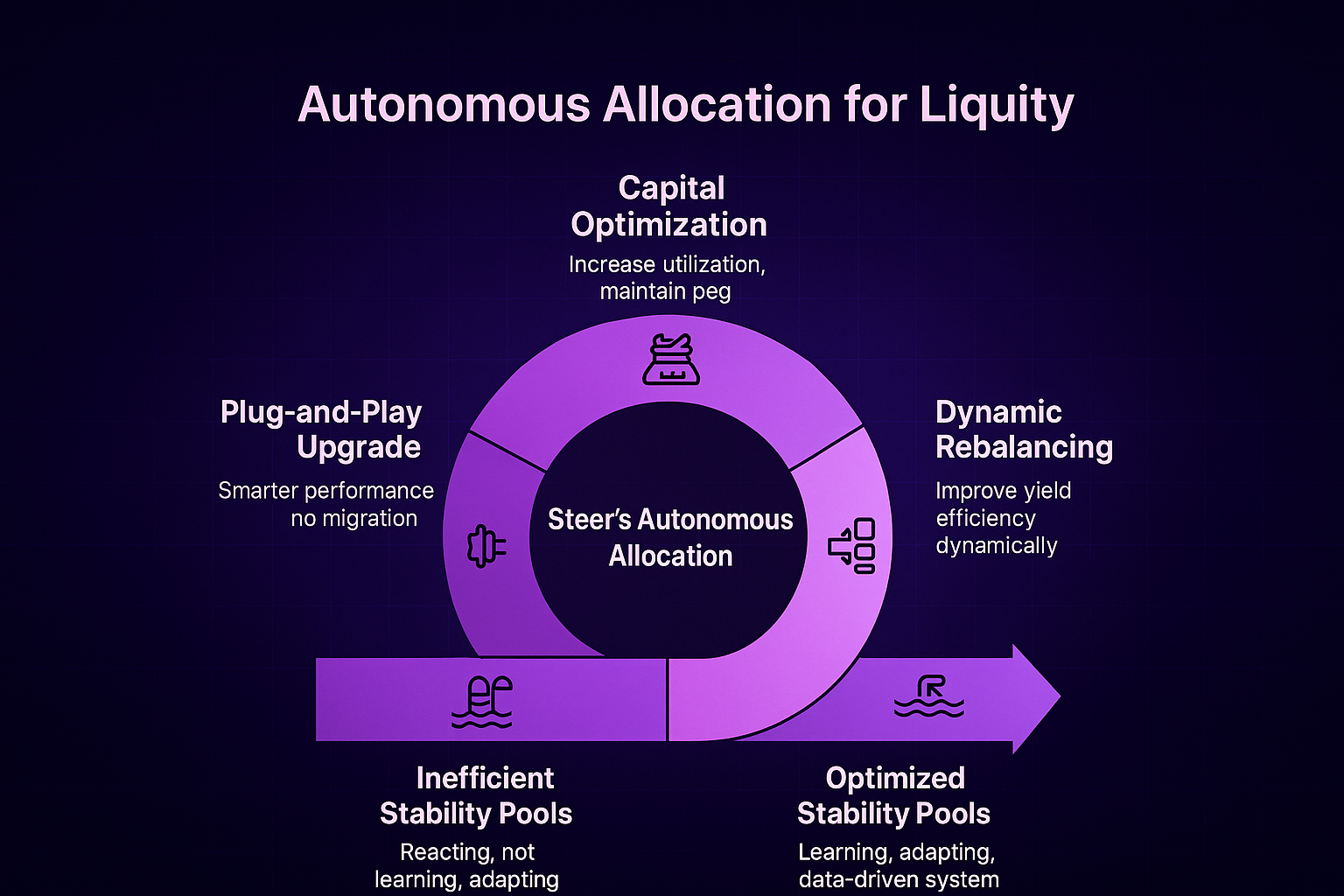
Automated liquidity systems depend heavily on indexed blockchain data.
Steer relies on this data layer for several critical workflows:
- powering frontend analytics dashboards
- generating price and candle feeds used by strategies
- triggering automated liquidity rebalancing
- integrating with decentralized exchanges and AMMs
Each workflow depends on fresh and synchronized data across chains.
If indexing falls behind the chain head, strategies may act on outdated information, and liquidity could be moved too late, or not at all.
For a DeFi protocol managing hundreds of markets simultaneously, this creates operational and financial risk.
Early attempts: custom indexing
Like many early DeFi teams, Steer initially experimented with running its own indexing infrastructure.
Operating custom indexers quickly proved difficult.
Blockchain indexing systems must handle several operational challenges:
- chain reorganizations
- RPC instability
- high event throughput
- concurrent query traffic
- indexing across many chains
Maintaining this infrastructure reliably required more engineering resources than expected.
The Steer team summarized the experience clearly:
“Anyone who writes their own indexing server is going down the wrong path. It’s a lot more complicated than it looks.”
To simplify their architecture, Steer adopted subgraphs as the standard interface for accessing blockchain data.
Why redundancy became necessary
Subgraphs solved the data modeling problem, but they did not fully solve the infrastructure problem.
Steer initially relied on the Graph decentralized indexing network.
In practice, the team encountered a common challenge with decentralized indexing systems: performance and reliability vary depending on which indexer serves the request.
This introduced several operational issues:
- some nodes fell behind the chain head
- query requests occasionally failed
- returned data could be stale or incorrect
For analytics dashboards, these issues are inconvenient. For automated liquidity systems, they pose a direct risk to user funds.
Liquidity strategies reacting to stale data can misplace capital or miss critical market movements.
To reduce this risk, Steer adopted a multi-provider indexing architecture.
Multiple providers ensure that strategies always have access to reliable blockchain data.
Ormi as a production indexing provider
Steer currently runs more than a dozen subgraphs across its infrastructure stack, indexing multiple chains and markets simultaneously.
Ormi became one of the providers supporting this system.
Steer uses Ormi to power several key components of its architecture:
- frontend liquidity analytics
- market data feeds consumed by strategy engines
- data pipelines used by automated compute modules
- integrations with decentralized exchanges
Steer’s liquidity automation system works by publishing strategy modules to IPFS and executing them across a distributed compute network.
These modules continuously monitor blockchain events through indexed data. When conditions change, liquidity positions are adjusted automatically.
Subgraphs provide the data layer that enables these decisions.
Reliable indexing is therefore a core dependency.
Why Steer chose Ormi
The Steer team evaluated indexing providers using a small set of operational criteria.
#1: Synchronization speed
Automated liquidity strategies must read the latest on-chain state.
Indexers that fall behind the chain head introduce incorrect inputs into the strategy engine.
Steer prioritized providers that maintained consistent synchronization across multiple networks.
“Reliability and sync time are the most important factors for us.”
#2: Stability under significant traffic load
Steer manages markets involving significant liquidity.
During periods of high trading activity, indexing infrastructure must remain stable.
According to the Steer team, Ormi maintained reliable performance across the chains they operate on.
“We haven’t had issues with your platform. That’s why you see us increasing our demand toward Ormi.”
#3: Data integrity
Liquidity strategies depend on accurate blockchain events.
High-volume markets such as Uniswap V3 pools generate large volumes of events. Missing or incorrectly indexed data can lead to incorrect liquidity decisions.
Steer reported no data integrity issues to date using Ormi.
This allowed their automation system to operate confidently across chains.
#4: Engineering support
Infrastructure providers occasionally require direct coordination with engineering teams.
Steer highlighted the responsiveness of Ormi’s engineering support in operational situations.
“For us it comes down to sync time and reliability. When you're automating liquidity across dozens of chains, stale data or failed requests aren't acceptable. Ormi has been consistently reliable, which is why we've continued expanding our usage.”
— Derek Barrera | Founder & CEO
Results: reliable infrastructure for multi-chain liquidity systems
With Ormi integrated into its indexing stack, Steer can operate automated liquidity infrastructure across dozens of chains and exchanges.
Ormi’s reliable indexing enabled Steer to:
- maintain accurate liquidity positions across markets
- power real-time analytics dashboards
- execute automated liquidity strategies safely
- integrate with multiple decentralized exchanges
For a protocol managing hundreds of markets across dozens of networks, reliable blockchain indexing is a critical piece of infrastructure.
Full customer story
About Steer Protocol
Steer is a decentralized abstraction layer for consumer protocols designed to enable the creation of omnichain applications on any web3 protocols.
Steer Protocol provides access to any web3 data sources, delivers a world-class developer experience, and offers specialized intent-based, compute within a high-performance network, thereby streamlines the development, deployment, and scaling of data-rich web3 applications, ensuring a user experience and efficiency comparable to that of web2 applications.
About Ormi
Ormi is the next-generation data layer for Web3, purpose-built for real-time, high-throughput applications like DeFi, gaming, wallets, and on-chain infrastructure. Its hybrid architecture ensures sub-30ms latency and up to 4,000 RPS for live subgraph indexing.
With 99.9% uptime and deployments across ecosystems representing $50B+ in TVL and $100B+ in annual transaction volume, Ormi is trusted to power the most demanding production environments without throttling or delay.