


Real-Time Blockchain Indexing: How Ormi Eliminated Subgraph Lag for Noks AI on Ethereum and BSC
Noks relied on real-time blockchain indexing to power AI-driven trading across Ethereum and BSC, but subgraph lag and missing blocks disrupted strategies. Ormi stabilized their indexing, delivering fresh, consistent, tip-of-chain data even under high throughput.


Noks is an omnichain execution layer for AI agents that trade across networks using on-chain activity, sentiment data, social signals, and wallet movements. Its users build strategies that combine technical indicators, liquidity triggers, and multi-step logic that must execute instantly on live market data. For systems like this, real-time data is essential. Any lag or missing block can break a strategy and lead to failed or costly trades.
The challenge
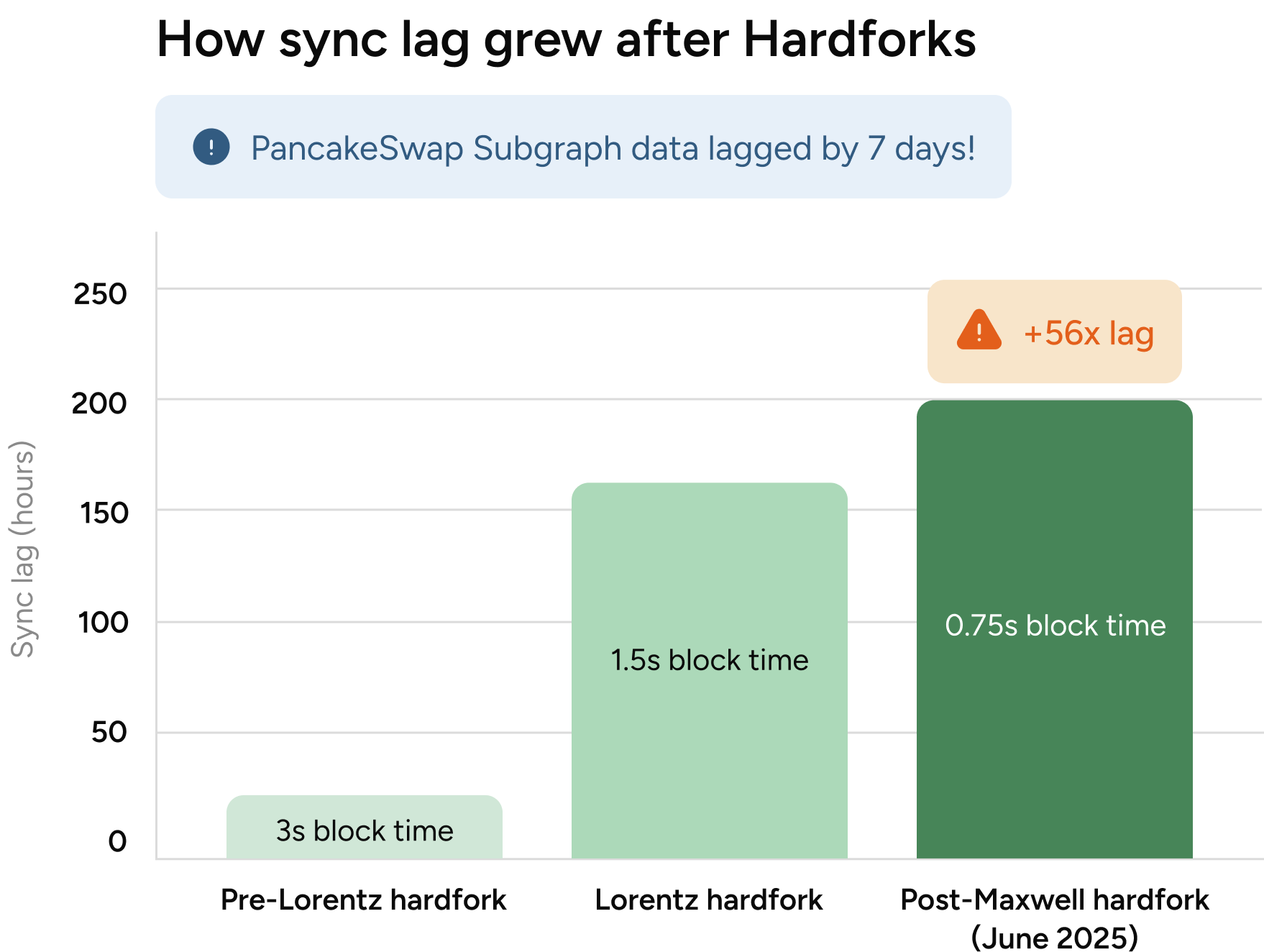
Noks operated four high-volume subgraphs on Ethereum and Binance Smart Chain, a network with fast block times and unpredictable traffic spikes. As usage grew, both subgraphs started drifting behind the chain head. Under sustained high TPS, database write pressure, and auto-generated indexes slowed inserts, while a recent Kubernetes migration introduced resource throttling
These issues created gaps in the data stream during the moments Noks’ AI agents needed precision the most.
How lag impacted Noks AI
Indexing lag had a direct impact on strategy execution:
- Signals fired late or failed entirely
- Orders were delayed or triggered incorrectly
- Agents reacted to incomplete or stale data
- Execution accuracy dropped during volatility
- Users lost confidence in automated trades
For a platform built on real-time intelligence, even a few seconds of delay changed outcomes and eroded trust.
“Our AI agents live or die on data freshness. On BSC, even a few seconds of lag breaks entire strategies. Ormi stabilized our indexing, kept us synced through volatility, and finally gave our execution layer the real-time reliability it needed.”
— Marek Lewandowski, CTO of Noks AI
Why didn’t other Subgraphs solutions work for Noks AI?
Noks tried several providers, but none could keep up with BSC’s throughput:
- Some struggled with outages or congested RPC sources
- Others had recurring issues with missing blocks
- Cloud-only setups are throttled under load
- Scaling behavior broke down during traffic spikes
- Providers offered limited visibility and few diagnostic tools
Even when latency appeared acceptable, the underlying data remained incomplete or was stale. For AI-driven execution, that was unacceptable.
Root causes
When Ormi evaluated the workload, two sets of bottlenecks became clear: one in the infrastructure, another in the subgraph logic
Infrastructure Issues
- I/O saturation during bursty block production
- Too many auto-generated database indexes
- Limited database parallelism
- Unbalanced pod resources after the Kubernetes migration
Subgraph Logic Issues
- Redundant load and save operations
- Repeated calculations in hot paths
- Duplicate writes
- Unused imports and logic branches
On a fast chain like BSC, even small inefficiencies quickly turned into visible data drift.
The solution
Ormi stabilized both subgraphs through infrastructure tuning and subgraph-level optimization.
All changes were orchestrated and validated through Ormi’s control plane, which continuously tracks block-head distance, query latency, and database throughput.
How we accelerated their indexing performance
- Increased database parallel workers and I/O concurrency
- Removed unnecessary indexes to reduce write pressure
- Tuned DB parameters to maximize effective usage of bare-metal server
- Rebalanced Kubernetes pod resources
- Updated real-time observability and monitoring
Subgraph optimizations proposed
- Reduced I/O-heavy load and saved calls
- Cached repeated calculations
- Streamlined event-handling logic
- Removed duplicate saves and unused imports
The infrastructure improvements alone produced immediate gains, even before all code changes were applied.
The results
After tuning and optimization, performance stabilized across the board:
- Indexing stayed consistent during peak BSC load
- Lag no longer accumulates over time
- Database operations became faster and more predictable
- Subgraphs remained within a few blocks of the chain head
- Volatility no longer caused missing data or execution gaps
With the remaining code optimizations applied, Ormi expects drift to disappear completely.
Why an indexer like Ormi is crucial
By running on Ormi’s vertically integrated data layer, Noks gained:
- Bare-metal performance with cloud elasticity
- Continuous validation across multiple RPC sources
- Redundant infrastructure resilient to BSC volatility
- Real-time indexing that stays at the tip of chain
This ensures every signal, trade, and action is powered by fresh and complete data. Behind the scenes, Ormi’s hybrid control layer continuously rebalances workloads across bare-metal and cloud regions to sustain real-time accuracy
Insights into AI use cases
High-frequency AI execution exposes weaknesses in legacy indexers immediately. Solving the problem requires strengthening:
- The infrastructure stack
- The indexing runtime
- The subgraph logic
With Ormi, Noks’ agents now react to the chain in real time. Our hybrid data layer ensures accuracy, uptime, and speed at the infrastructure level so every strategy executes on the freshest, most accurate data possible.
About Noks
Noks AI provides a no-code platform for creating and automating trading agents on decentralized exchanges. The system converts natural-language instructions into executable strategies that operate directly on-chain.
It is built on the idea that modern trading tools should be as flexible and powerful as contemporary data tools. The platform streamlines strategy development and execution, enabling AI-driven automation that reacts in real time to market conditions.
About Ormi
Ormi is the next-generation data layer for Web3, purpose-built for real-time, high-throughput applications like DeFi, gaming, wallets, and on-chain infrastructure. Its hybrid architecture ensures sub-30ms latency and up to 4,000 RPS for live subgraph indexing.
With 99.9% uptime and deployments across ecosystems representing $50B+ in TVL and $100B+ in annual transaction volume, Ormi is trusted to power the most demanding production environments without throttling or delay.