


Case Study: How Balancer Rebuilt Trust in Its Data Infrastructure with Ormi
How Balancer rebuilt trust in its data infrastructure with Ormi, and why real-time, reliable blockchain data is critical for DeFi systems running in production.

Balancer is one of DeFi’s largest automated market makers, with more than $130B in cumulative trading volume, over $134M in current TVL and deployments across 13 chains.
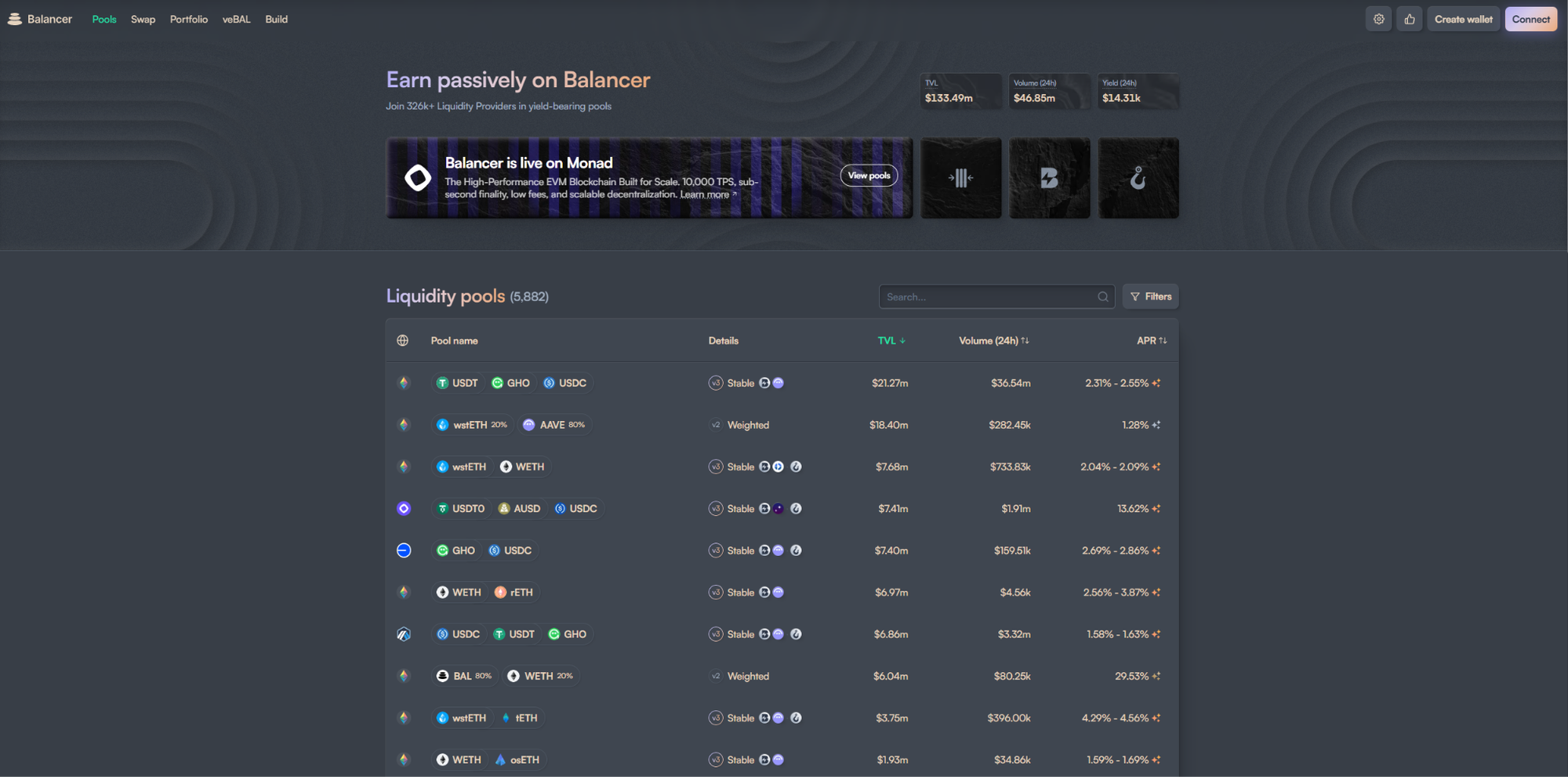
Launched in 2020, Balancer specializes in fungible and yield-bearing liquidity. It also serves as infrastructure for other protocols that build pools and products on top of it.
Because Balancer handles user funds and powers downstream applications, its data layer needs to be accurate, consistent, and available in real time.
Use case
Balancer’s data stack pulls from multiple sources: RPC nodes, external pricing APIs, and subgraphs for everything stateful. In total, Balancer operates 48+ subgraphs on Ormi, reflecting the scale and complexity of its indexing needs.
That includes:
- pool indexing
- user positions and balances
- swap events
- the aggregations built on top of them
This data flows into a backend pipeline, where it is enriched and served through APIs to dashboards, analytics, and applications built on top of Balancer.
The challenge
The team relied on hosted indexing services, supplemented by other providers for broader network coverage. Over time, two issues became harder to ignore.
First, the data layer struggled to keep pace with the protocol's demands. In some cases, indexed data did not fully reflect on-chain events. Because Balancer’s aggregates are built on raw swap data, even a single missing event could distort snapshots and downstream rollups. These gaps were not always obvious at first and often surfaced only after discrepancies appeared in production.
Second, the cost-to-value equation started to break down. As usage grew, engineering hours increased to maintain the data layer. Over time, the effort required to maintain reliability outweighed the value of staying on the existing setup.
For a protocol operating at this scale, data accuracy and reliability are essential to how the platform operates.
Evaluating a new provider
When Balancer began evaluating alternatives, the criteria were clear.
The team prioritized:
- data accuracy
- reliability under load
- latency
In that order.
They were not looking for the cheapest option. They needed an indexing provider they could trust in production.
Why Ormi
Balancer’s requirements were straightforward: the data had to be correct, available, and usable in production. Ormi addressed these directly.
The missing-event problem was resolved. With previous providers, issues often surfaced through broken aggregates. With Ormi, swap data consistently matched on-chain activity, giving the team confidence that the underlying data was complete.
Performance held up under real load. Subgraphs remained stable during production traffic, without the degradation Balancer had seen elsewhere. Even small delays can propagate into user-facing metrics, so consistency mattered.
Pricing was easier to reason about. After dealing with rising and opaque costs, Ormi’s model was straightforward and predictable, making it easier to plan without hidden tradeoffs.
Support tied it all together. When issues came up, they were resolved quickly, reducing the risk of small problems turning into production incidents.
“Previous providers created uncertainty we had to actively manage. We spend far less time validating and maintaining the pipeline, which lets us focus on the product instead.”
— Franz | Core Dev at Balancer
The outcome
Moving to Ormi changed how the team operates.
With a more streamlined infrastructure layer, the system became simpler to maintain. The team no longer needed to allocate engineering resources to data reliability, freeing capacity for protocol development.
This shift also made planning more straightforward. Costs are predictable, and the indexing layer behaves consistently under load.
For a protocol that other protocols build on, reliability and accuracy are critical.
Balancer can treat its data as a source of truth and focus on building on top of it rather than validating it.
About Balancer
Balancer is a programmable and customizable DEX and AMM infrastructure supporting multiple pool types: Weighted and Stable Pools (both available as Boosted for yield generation via lending protocols), and Fungible CL pools. All pools are extendable via V3 hooks for custom logic.
About Ormi
Ormi is the next-generation data layer for Web3, purpose-built for real-time, high-throughput applications like DeFi, gaming, wallets, and on-chain infrastructure. Its hybrid architecture ensures sub-30ms latency and up to 4,000 RPS for live subgraph indexing.
With 99.9% uptime and deployments across ecosystems representing $50B+ in TVL and $100B+ in annual transaction volume, Ormi is trusted to power the most demanding production environments without throttling or delay.